Polymarket Prices Wednesday’s Fed Hike at 79.5%. CME…
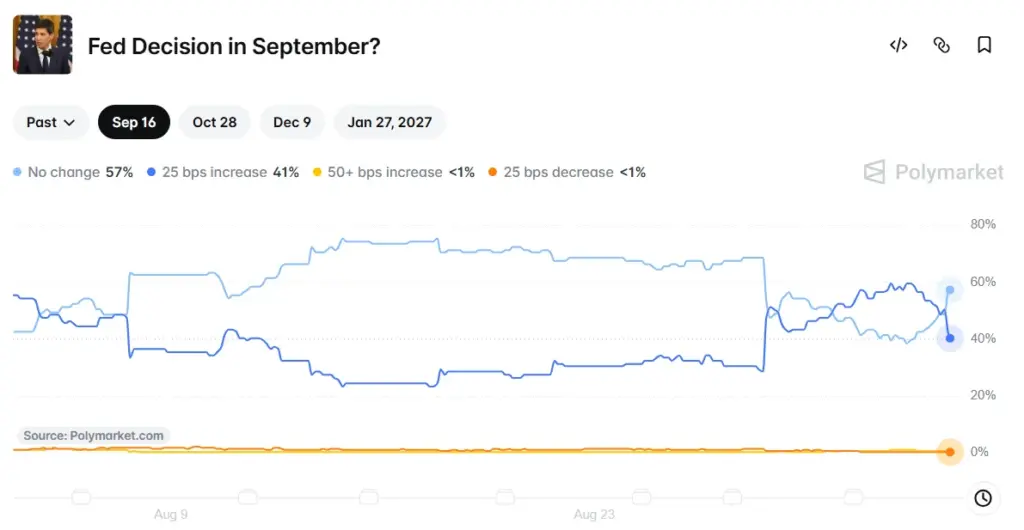
Updated 12 September 2026. Polymarket’s “Fed Decision in September?” book prices a 25 basis point increase at 79.5%, with no change at 20.5% (read directly from Polymarket’s public market data at 08:45 UTC+3 on 12 September; 24-hour volume on the event, $19.6 million). CME’s FedWatch tool, which derives its probability from fed funds futures rather than from a binary book, was reported near 86% after Thursday’s CPI print by CNBC and near 90% by CBS News. Verdict: both instruments now say a hike on Wednesday is the base case. They disagree by six to ten percentage points, and that gap is not noise – it is two different instruments measuring two different things, which is worth understanding before you read either number as “the market’s view”.
Key facts
- The FOMC meets 15-16 September, with the decision at 2:00 p.m. ET on Wednesday 16 September. It is a Summary of Economic Projections meeting, so the committee publishes its rate path alongside the statement.
- The current federal funds target range is 3.50% to 3.75%. A 25 basis point increase takes it to 3.75% to 4.00% – which is what EY-Parthenon projects, and what both prediction markets and futures are pricing as the base case.
- Polymarket, read live on 12 September: 25bp increase 79.5%, no change 20.5%, 50bp or more increase 0.65%, 25bp decrease 0.35%, 50bp or more decrease 0.05%. The event carried $19.6 million in 24-hour volume, making the Fed the largest active book on the platform.
- CME FedWatch, as reported: CNBC put the odds of a quarter-point increase at nearly 86% after the CPI release, up from 72% on Thursday. CBS News described the same post-CPI repricing as nearly 90%. Before the print, markets were at roughly 70%.
- What moved it was one tenth of a percentage point. August core CPI rose 0.3% on the month against a 0.2% consensus. Headline CPI rose 0.4% on the month and 3.4% over twelve months, matching expectations (U.S. Bureau of Labor Statistics, released 11 September 2026).
- The trajectory has been one-directional since August. FedWatch odds for a September hike stood at 44.4% on 7 August and had reached 60.6% by early on 8 September, before the CPI print took them into the mid-to-high 80s.
- Fed Chair Kevin Warsh has said the quiet part out loud. On inflation returning to the 2% target, he said that if the numbers do not improve, “we have work to do” – remarks widely read as an endorsement of a hike.
Why two markets on the same event disagree
The instinct is to treat the divergence as one of the two being wrong. It is better understood as the two measuring different quantities.
CME FedWatch is a derivation, not a vote. It infers a probability distribution from the pricing of fed funds futures contracts. Those contracts settle on the average effective fed funds rate over a calendar month, so a September implied probability is a piece of arithmetic performed on a monthly average, with assumptions baked in about the timing of the move within the month. It also reflects a market whose participants are largely institutions hedging rate exposure, not people expressing a view on one meeting.
Polymarket is a direct binary. Its contracts resolve on what the FOMC actually announces on 16 September. There is no averaging, no timing assumption and no interpolation. What you get in exchange is a book with real frictions: capital is locked until resolution, so a contract trading at 79.5% four days out is not the same economic proposition as one trading at 79.5% four hours out. That friction structurally compresses prices away from the extremes, which is one plain reason a binary book reads lower than a futures-implied number when the futures number is high.
And the reported FedWatch figures themselves are not one number. CNBC published nearly 86%, CBS News nearly 90%, for the same tool on the same afternoon. FedWatch updates continuously as futures trade, so two outlets reading it an hour apart get two answers. Anyone quoting a single decimal place for “the market’s odds” is quoting a timestamp they have not disclosed.
Outcomes priced for the 16 September decision
Polymarket implied probabilities, read directly from the platform’s public market data at 08:45 UTC+3 on 12 September 2026. These move continuously; the timestamp is part of the data.
| Outcome | Polymarket implied probability | Resulting target range | Note |
|---|---|---|---|
| 25bp increase | 79.5% | 3.75% – 4.00% | The base case on both instruments. CME FedWatch was reported at nearly 86% (CNBC) to nearly 90% (CBS News) for the same outcome. |
| No change | 20.5% | 3.50% – 3.75% | The live alternative, and it is not trivial. One in five is not a rounding error four days out from an SEP meeting. |
| 50bp or more increase | 0.65% | 4.00% – 4.25% or higher | Effectively excluded. Nothing in the August data argues for doubling the increment. |
| 25bp decrease | 0.35% | 3.25% – 3.50% | Excluded. A cut with headline CPI at 3.4% is not on the table. |
| 50bp or more decrease | 0.05% | 3.00% – 3.25% or lower | Excluded. |
Read the top two rows together and the distribution is the story: roughly four-to-one for a hike, with essentially nothing in the tails. This is a market that has settled on the direction and the size, and is arguing only about whether the committee goes now or waits.
How far this has moved, and how fast
Three weeks ago the hike was a coin flip at best. FedWatch had it at 44.4% on 7 August. By the early hours of 8 September it was 60.6%, driven by a stronger-than-expected August jobs report and hawkish remarks from Warsh at Jackson Hole. Prediction markets lagged that move: Polymarket was reported around 49% and Kalshi around 57% in that same pre-CPI window, both well below the futures-implied figure.
Then Thursday’s PPI and Friday’s CPI arrived, and the repricing was violent. FedWatch went from about 72% to the mid-80s in an afternoon on a core print that beat consensus by a single tenth. Polymarket went from roughly 49% to 79.5%. The binary book closed most of the gap, but not all of it – which is the pattern you would expect from an instrument whose holders pay a carrying cost to be right early.
What the oil complex is doing to this decision
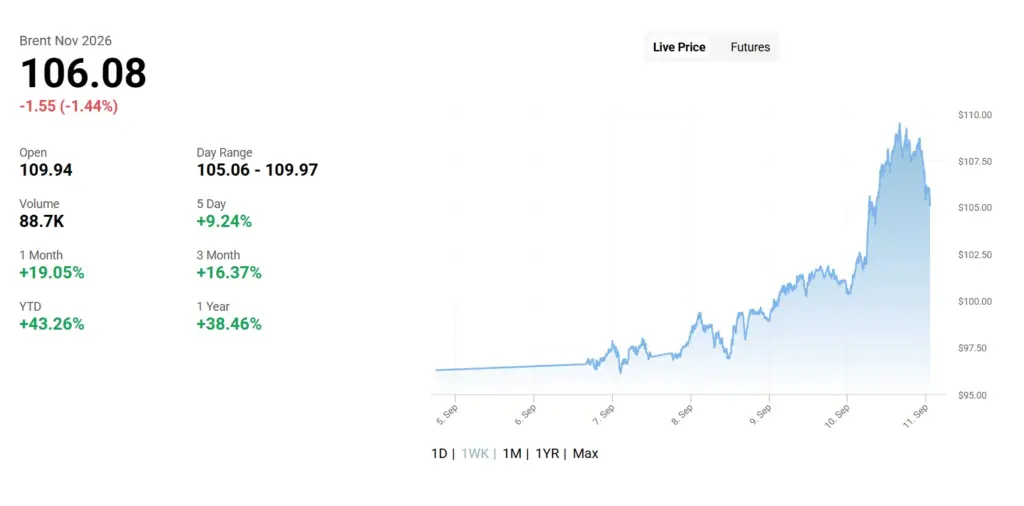
The Fed is not deciding in a vacuum. Brent settled at $104.61 on 11 September and closed the week up roughly 9% as Houthi forces took Perim Island in the Bab el-Mandeb and the Saudi pipeline built to bypass the Strait of Hormuz was struck and shut. Energy is the channel through which a Red Sea territorial change reaches a U.S. inflation forecast, and it is pushing in the same direction as the core print.
That matters for how Wednesday is framed rather than for whether it happens. A committee raising rates into an oil-driven price shock has to decide publicly whether it is treating that shock as transitory or not, and the Summary of Economic Projections is where that answer gets written down.
What to watch next
- The statement language, not the 25 basis points. The increase is largely priced. Whether the committee signals this is the last move or the first of several is the part the market has not priced, and it is the part the SEP will speak to.
- Whether the two instruments converge before Wednesday. As resolution approaches, the carrying-cost friction on a binary contract shrinks. If Polymarket does not close the gap to FedWatch by Tuesday, that is a genuine difference of opinion rather than a mechanical spread.
- The dissent count. An SEP meeting with a 20% no-change probability priced is a meeting where dissents are plausible. The vote split will tell you more about October than the decision itself does.
- Oil. Brent above $100 with both chokepoints on the Gulf-to-Europe route contested is a live upside risk to the inflation path the committee publishes on Wednesday.
Quick take: Polymarket says 79.5%, CME FedWatch was reported anywhere from nearly 86% to nearly 90%, and both are correct about their own instrument. FedWatch is arithmetic on fed funds futures that settle on a monthly average; Polymarket is a binary that resolves on what the FOMC says on 16 September, with capital locked until it does. The useful number is not either figure on its own but the shape both agree on: roughly four-to-one for a 25bp increase to 3.75-4.00%, nothing in the tails, and a one-in-five chance the committee waits. What is genuinely unpriced is the framing – whether Wednesday is the end of the tightening or the start of it.
Frequently asked questions
When is the September 2026 Fed decision?
The FOMC meets 15-16 September 2026 and announces its decision at 2:00 p.m. ET on Wednesday 16 September, followed by a press conference. It is a Summary of Economic Projections meeting, so the committee also publishes updated forecasts and its rate path.
What are the odds of a Fed rate hike in September 2026?
Polymarket priced a 25 basis point increase at 79.5% when read on 12 September 2026, with no change at 20.5%. CME FedWatch was reported at nearly 86% by CNBC and nearly 90% by CBS News after the August CPI release on 11 September. All of these figures move continuously, so a percentage without a timestamp is not meaningful.
Why do Polymarket and CME FedWatch show different numbers?
They are different instruments. FedWatch derives a probability from fed funds futures, which settle on the average effective rate over a calendar month and therefore require assumptions about the timing of a move. Polymarket contracts resolve directly on the FOMC announcement, but holders lock up capital until resolution, a friction that tends to keep binary prices away from the extremes.
What would a hike do to the federal funds rate?
The target range is currently 3.50% to 3.75%. A 25 basis point increase takes it to 3.75% to 4.00%, which is the level EY-Parthenon projects for this meeting.
What in the August CPI report changed the odds?
Core CPI, which excludes food and energy, rose 0.3% on the month against a 0.2% consensus. The headline figures – 0.4% on the month and 3.4% over twelve months – came in as expected. The single-tenth core miss was the line the market reacted to, because core is the series the Fed watches for inflation persistence.
Is a rate cut possible on 16 September?
Polymarket prices a 25 basis point cut at 0.35% and a larger cut at 0.05%. With headline inflation at 3.4% and the Fed chair saying there is “work to do”, a cut at this meeting is not a live scenario.
Could the Fed raise by 50 basis points?
Polymarket prices that at 0.65%. Nothing in the August data supports doubling the increment, and no member of the committee has publicly argued for it.
How much money is actually trading on this?
Polymarket’s September Fed decision event carried $19.6 million in 24-hour volume when read on 12 September 2026, making it the largest active market on the platform at that moment.
Related coverage
- CPI at 3.4% and the 30-year Treasury yield at a 19-year high – the print that repriced this decision, and what it did to the long end.
- Gold at $4,385 after August CPI as hike odds run toward 90% – why bullion rose on a hawkish print.
- Bitcoin at $77,400 after August CPI and a 0.3% core print – the crypto read on the same repricing.
- Polymarket wallets bet $3.6 million against the CLARITY Act passing in 2026 – how to read a prediction-market book when the headline number is the least interesting part of it.
Sources: Polymarket public market data for the “Fed Decision in September?” event, read 12 September 2026 at 08:45 UTC+3; U.S. Bureau of Labor Statistics (Consumer Price Index Summary, August 2026, released 11 September 2026); CNBC; CBS News; Yahoo Finance; Trading Economics (federal funds target range); Fox Business; EY-Parthenon projection as reported; OilPrice.com and Trading Economics for Brent settlement.
This article is for information only and is not financial advice. FinanceFeeds does not recommend buying or selling any asset, and nothing here is a recommendation to trade prediction markets, futures or any other instrument. Markets carry risk, including the risk of losing more than your initial outlay. Do your own research and consider speaking to a regulated adviser before making any investment decision.